The Dead Pay Half
- story-driven
- Difficulty: expert
- About 600 min
- solo
- Game Systems: Combat (New), Ambient Audio (Live), Dynamic Portraits (Live), World Map (Live), Party Members (Live)
What you do
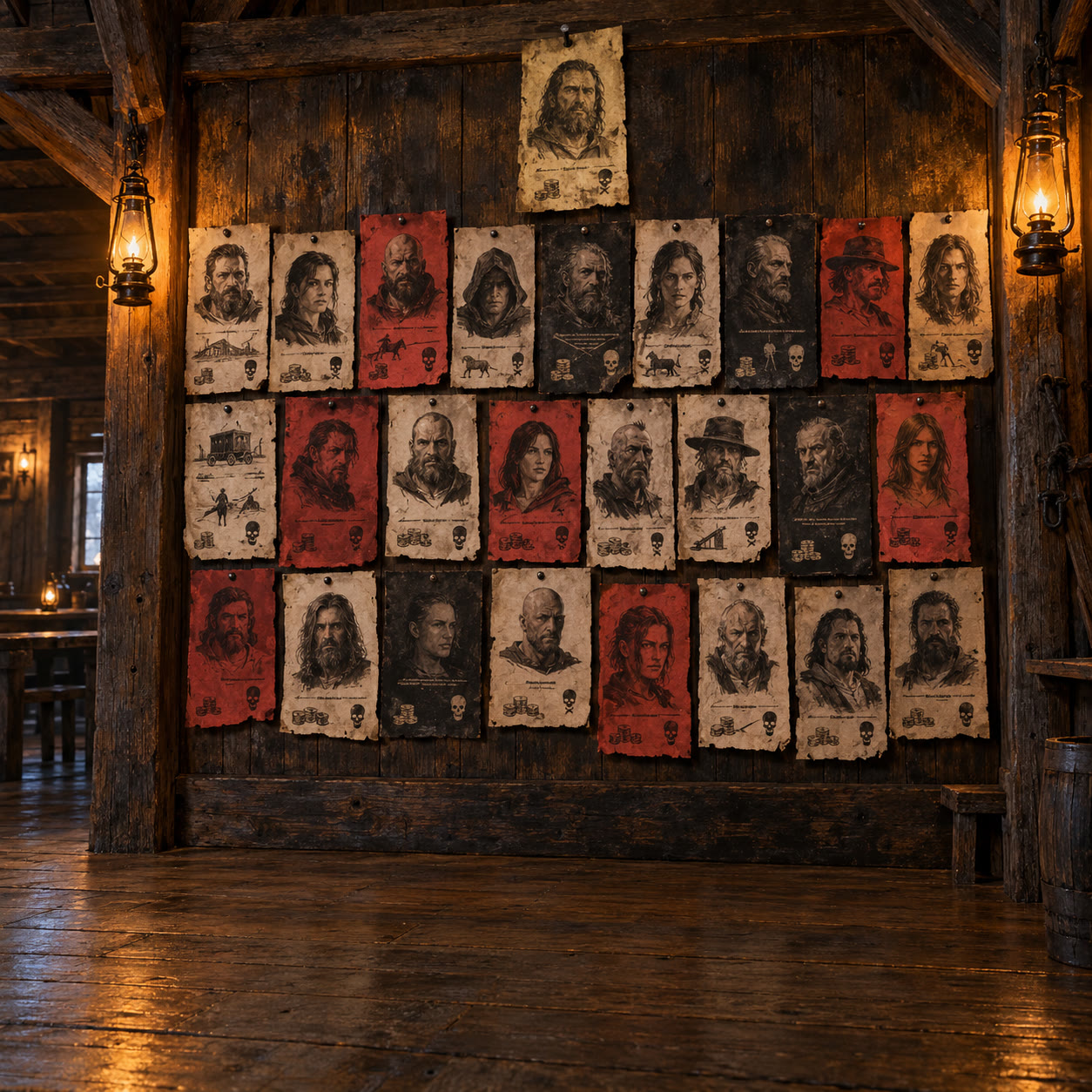
You ride writs out of Owing, a mud-street town. A writ is a wanted paper posted on the town's board. Every writ prices an outlaw twice: brought in tied and breathing, or a tag cut from the body as proof, for half. Hunt the people on the board and take the work the road offers. Decide what to do with each person you catch: hand them in, hire them or let them go. Fights are turn-based and settled by real dice, and the wounds you take carry forward. You never die: lose a fight and you wake hurt in the infirmary, and the winner takes a toll.
Each writ, a wanted paper on Owing's board, prices a body twice. Hauled in tied and breathing pays full; a tag cut off the corpse pays half. Six doors to six realms died in one night six winters ago. The magic they bleed into the ground belongs to the Receivers, a Brasslock money house, by charter. Ride writs and decide each catch: kill them where they kneel, jail, hire or free them. Wounds are named, debts chalked on the wall, and the Half-Price Ground graveyard fills with names you put there.
Plays in a web browser on a desktop or laptop computer.
Free to start, no card needed: 50 Embers on sign-up (approx 1 hour sample of standard play, estimate based on typical story play), then 15 a day.
Early Access
The Dead Pay Half
Six Dead Doors
This is the Fray, a ragged frontier at the end of the coach road. Nine winters ago the Homeward Company opened a crossing here: six doors, one to each of six realms. They stand in a ring round a forecourt of pale stone, deep in the Six Dark. Six winters ago all six died in one night, the Shutting. Its dead still lie where they fell. Since the winter after, the doors have bled magic, called bleed, into the ground. It glints in the grit like hail that never melted. Buckles, bones and blades come out of the dead halls strange.
A Board in Owing
By the Receivers' Charter, the law of the Fray, that bleed belongs to the Receivers. They are door-money, a Brasslock money house that lost a fortune on the Homeward. Their silver built a warden-house in Owing, the mud-street town where every road in the Fray ends. One wall of its timber hall is covered in writ papers, wanted notices held by pins. White is for road nuisances, red for blood, black for gang heads. Every paper carries a painted face, the crime and two prices.
Two Prices
A target brought in tied and breathing pays double, and the warden-house gets its trial. A tag cut off the body pays half, and the gravedigger gets a name to cut. Kill them where they kneel, lock them in the cells, hire them, bed them, or cut the rope and let them go. Five sides will each remember which, the warden-house among them. The Tithe takes a tenth of all that moves on the road. The Porters smuggle bleed down the river. The Grind runs the fighting pit on the Salt. The stranded camp at the doors, waiting for a way home.
The Top Writ
One paper hangs apart on its own nail, yellow with six winters, and nobody has cashed it. It names the woman who still holds the dead doors. Whoever reaches her decides what the crossing is for: sealed, claimed or sold.
What Awaits
- Three ways in: The Blade, The Bruiser or The Relic-runner
- A board of writ papers in white, red and black, each priced alive and dead
- A pit fight on a salt floor, a card table and the Hanged Oak
- A romance on either side of the law, each with its price
- One choice at the end the whole Fray talks about
The first pin on the board is loose, and the paper under it has a face and two prices.
Content notes
Contains: killing for pay and the killing of bound prisoners, with wounds named; captivity, gagging, humiliation and hard questioning; debt and debt-bondage; hangings and the unburied dead; desire between adults, plain-spoken.